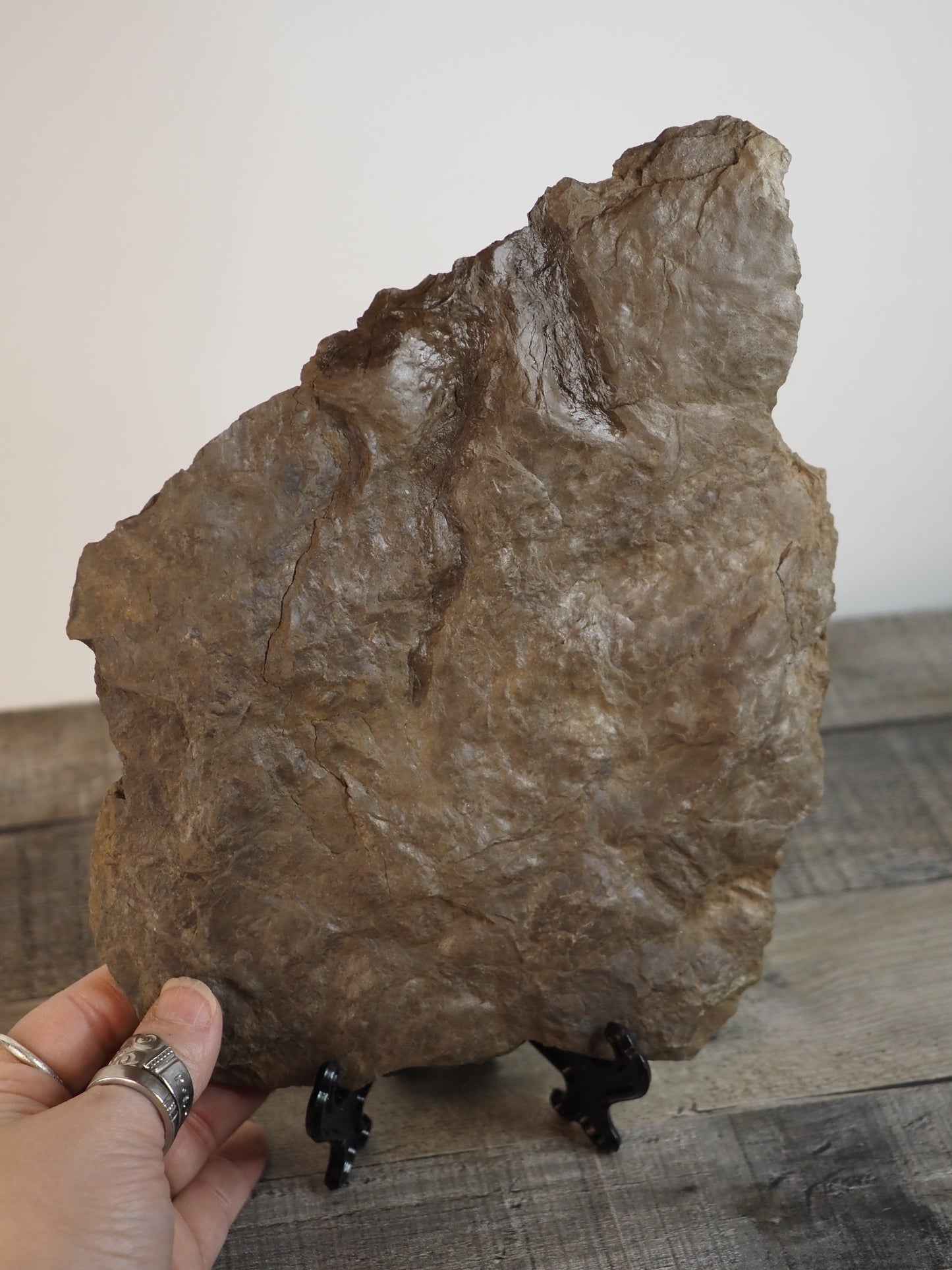


Dinosaur Footprint Track from Connecticut - Grallator B
Dinosaur Footprint Track from Connecticut - Grallator B
Couldn't load pickup availability
This Grallator dinosaur footprint is from the Jurassic East Berlin Formation of Connecticut, not far from Connecticut's Dinosaur State Park (It did not come from the park, itself, as gathering specimen is illegal in order to preserve the park's history and beauty.)
The print is in a matrix stone of about 9.75" x 8". It will come with a stand similar to the one it is photographed with.
And although we know you're here for the footprint, the mica content of this particular shale gives it a beautiful shimmer!
Be sure to click the "science" tab for more information!
History | Science
History | Science
This dinosaur footprint from the Jurassic East Berlin Formation of Connecticut is a Grallator Print, which, rather than a particular species of dinosaur is more of a record keeper of a group of small, three-toed prints made by a variety of bipedal theropod dinosaurs. This variety of print is found in many places around the world dating from the early Triassic all the way through the Cretaceous Periods. Most, such as these, can be found in the late Triassic - early Jurassic formations of North America's east coat.
These prints mark a time in the early Jurassic Period (around 200-175 million years ago) when the dinosaurs who made these prints were undergoing major change. As Pangea began to break apart, they were evolving from the smaller animals of the Triassic to the diverse and much, much larger creatures that would become the dinosaurs we know and love! We will most likely never find the remains of these particular dinosaurs, but having records of their footprints makes them an important part of the fossil record during a time that is so long ago that there is comparatively very little to find!
Dinosaur prints are trace fossils, meaning they are evidence of ancient life that has been preserved for more than 10,000 years. (In this case, MUCH longer than that!). They occurred when a dinosaur would step down into soft, mushy sediment, usually bordering a body of water. The mud or clay would dry out, and the print would then be covered and filled-in by more sediment. Over time, that sediment would build up, creating pressure and turning all of that sediment to stone. Then, through either geological uplifting or erosion of the softer not-yet-stone layers, usually caused by water, the footprints would come back into view, telling the story of the ancient creatures who walked the land, millions of years before!
Disclaimers
Disclaimers
Photography
Although we always strive to provide clear, accurate images of our crystals and other products, we photograph under professional lighting, which is meant to mimic sunlight. If you get your crystal and think it looks a little different under low or artificial light, try checking it out again in sunlight!
Our crystals are one-of-a-kind art, created by nature.
No two pieces are the same, and there is no such thing as "perfection" in nature.
When it comes to our hand-carved items, remember that artists work with and around imperfections, druzy pockets, and other natural variations to bring each carving out of a piece of natural stone.
We consider these imperfections to be one of the most wonderful parts of crystal collecting, and we invite you to embrace each carving's uniqueness!
We will always try to portray each piece honestly, so be sure to look closely at our images and videos to ensure you know what to expect.
Metaphysical Information
Metaphysical information mentioned anywhere by The Triceratory should not be considered medical advice and is not meant to be used in place of needed medical treatment.
Share